Best Filament Storage Solutions: Keep Your Spools Dry Without Wasting Money
Quick answer
Start with resealable storage bags and rechargeable desiccant packs for under $20 total. If you are running multi-spool or AMS setups, add a vacuum sealer kit to create long-term dry storage that pays for itself after two salvaged spools. Skip the fancy electronic dry boxes until your filament budget justifies them.
Your filament is quietly absorbing water right now. Probably. PLA starts pulling moisture within hours of opening its original bag, and that moisture turns into stringing, blobs, popped pellets, and prints that feel like sandpaper instead of smooth plastic. The difference between a great print and a trash pile is often the humidity in your spool bag.

This guide contains affiliate links to the products I would actually buy. If you purchase through them, I may earn a commission at no extra cost to you. I'm trying to keep your filament dry and my operation funded. Two birds, one algorithm.
Here's what every storage solution needs to do: create a sealed environment, remove moisture that's already there, and actually be something you will use consistently. The fancy solutions fail because they sit on the shelf collecting dust. The cheap solutions win because they are in your workflow.
Why Moisture Ruins Your Prints
When filament absorbs moisture, water inside the plastic turns to steam during extrusion. That steam creates micro-bubbles in the molten material, which show up as:
- Stringing and oozing — thin threads between printed features even when retraction looks fine.
- Popping or crackling sounds from the nozzle during prints, like someone is frying popcorn inside your hotend.
- Rough surface texture — tiny bumps and pitting that look like you printed in a sandbox.
- Loss of mechanical strength — parts snap or bend where they shouldn't because the polymer chains are degraded.
If your printer settings were fine last week and suddenly everything looks terrible, check your filament humidity before spending an hour tuning retraction. Moisture is the silent variable in every failed print.
Solution #1: Desiccant Packs (The $7 Fix)
Cheapest and fastest to deploy
Rechargeable desiccant packs are the filament storage equivalent of putting on a seatbelt — small effort, massive protection. You drop them into your sealed storage bags or containers alongside your spools, and they pull ambient moisture out of that enclosed space. The silica gel beads turn from blue to pink (or orange to green) when saturated, so you can see exactly when it's time to refresh them.
A good set of rechargeable desiccant packs on Amazon costs about $7 and will keep multiple spools dry for months. You can reuse the same packs by drying them in a 200°F oven for an hour or leaving them in direct sunlight for a day. They are not glamorous, but they work, and a $7 pack of moisture absorbers is infinitely more valuable than three failed prints because your filament went damp sitting in an open tub.

Solution #2: Resealable Storage Bags + Desiccant (The $15 System)
Best bang for the buck
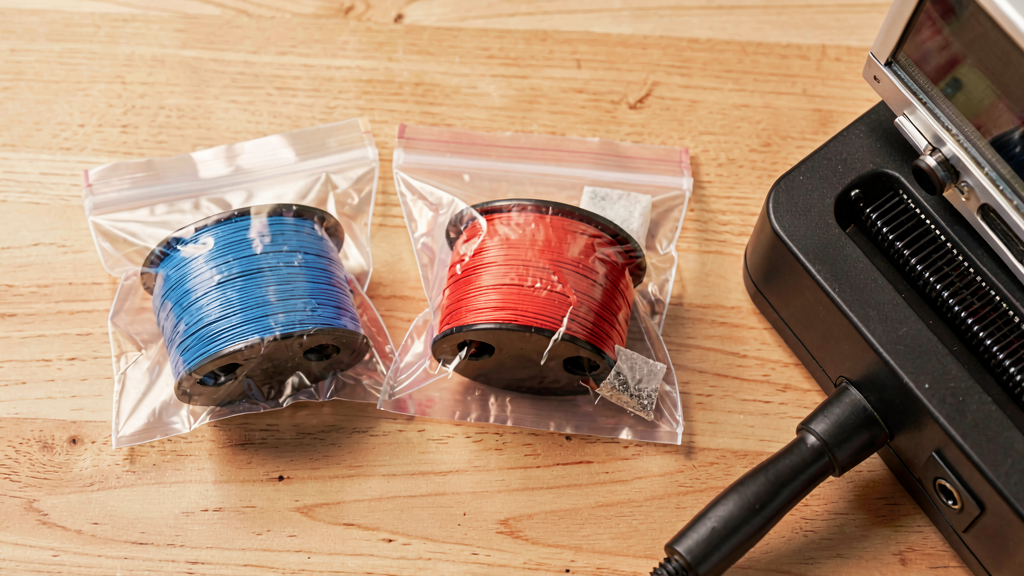
The original bags Amazon ships filament in are fine until you open them. After that, the zip seal is more "suggestion" than actual barrier against humidity. Upgrading to proper heavy-duty storage bags with double-zip seals creates a much tighter environment for your desiccant packs to work inside.
You do not need branded filament bags costing $20 for one. Thick resealable bags designed for food or vacuum sealing work just as well at half the price, and they create the sealed environment that makes everything else in this guide actually effective. Combine these with desiccant packs from Tier 1 and you have a storage system under $15 that outperforms a $60 cheap dry box.
Solution #3: Vacuum Sealer for Filament (The Serious Setup)
Long-term storage that pays for itself
If you are running an AMS setup or keep more than two spools on hand at once, passive bags and desiccant eventually need a harder seal. A vacuum sealer removes the air entirely from your storage bags, creating near-zero humidity environment that keeps filament shelf-stable for months — even years if you store them cool and dark.
The vacuum sealer I keep on hand is not fancy. It pulls air from chamber-style or handheld-compatible bags, reseals them properly, and costs less than a single bottle of specialty filament. The math works out: one salvaged spool of damp PETG that was going to turn into stringy garbage pays for the entire system.

What About Filament Dryers?
This is where I need to be honest about what does and does not fix the problem. A filament dryer is a treatment tool, not a storage solution. It actively heats damp filament while circulating dry hot air around it, reversing the moisture absorption. That is genuinely useful for salvaging spools that have gone bad.
But a dryer does nothing if your "storage" after drying is tossing the spool back into an open cardboard bin on a shelf. You need to dry the filament AND then seal it properly with desiccant in a closed bag, or you just paid $40 to temporarily fix what will get damp again within two days.
If your budget only covers one thing right now, skip the dryer and invest in proper bags plus desiccant packs first. Prevention beats cure every time, and keeping moisture out is cheaper than removing it later.
The Storage Decision Matrix
| How many spools? | Start here | Upgrade when... |
|---|---|---|
| 1-2 active spools | Desiccant packs + original bags | You open a third spool regularly |
| 3-5 spools rotation | Heavy-duty storage bags + desiccant | You want to batch-seal for long-term storage |
| AMS + backup spools | Vacuum sealer + desiccant bags | You print hygroscopic materials (nylon, TPU) |
Storage by Filament Type
Not all filament is equally needy about humidity. Here's what needs extra care:
- PLA / PLA+ — Tolerates moderate humidity for a few days, but degrades noticeably after a week in damp environments. Desiccant bags are sufficient.
- PETG — Very hygroscopic. Absorbs moisture faster than PLA and shows popping/stringing quickly. Seal it immediately and keep desiccant inside the bag at all times.
- Nylon / PVA / HIPS — Extremely moisture sensitive. These need vacuum sealing or a dedicated dry box from day one, no exceptions.
- Silk / specialty PLA — Behaves like regular PLA but surface finish quality drops noticeably if damp. Worth storing carefully to get the glossy look you paid extra for.

Bottom Line
Filament storage is the cheapest upgrade to print quality that exists. Under $15 gets you a system that prevents most humidity problems, and adding a vacuum sealer later creates storage so effective your filament will outlast your printer warranty. Start with desiccant packs today — they work immediately, and the worst case scenario is that you have slightly drier spools than you did yesterday.
Keep reading if you want more:
- Stop Buying Overpriced 3D Printer Accessories — the storage stuff I would skip and what actually matters.
- Best 3D Printer Accessories for Beginners — the full starter gear list, storage included.
- Filament Buying Guide — choosing spools worth storing carefully in the first place.
Related Posts
Buying Guides
Best Gridfinity Generators Compared (2026)
Four Gridfinity bin generators tested and compared in 2026: Tooltrace, GridPilot, GridFinityGenerator, and OnShape FeatureScript. Pricing, export formats, free tiers, and which one to pick for your workshop.
2026-10-08Buying Guides
How Much Does Multi-Color Actually Cost? (AMS, Purge Waste, and the H2C That ...
Multi-color 3D printing looks magic on camera and expensive on the filament scale. A real breakdown of what AMS purge waste, spools, and the new H2C Vortek hotend swap actually cost per print, and where the money is quietly going.
2026-09-21Buying Guides
Stop Buying These 7 Overpriced 3D Printer Accessories (Buy This Instead)
Seven 3D printer accessories beginners are often told to buy too early, plus the cheaper tools and upgrades that solve real problems instead.
2026-06-22This page may contain affiliate links. As an Amazon Associate I earn from qualifying purchases.